“Poets are damned but they are not blind, they see with the eyes of angels.”
― William Carlos Williams
― William Carlos Williams
Note how Wiliams' poem mimics the rhythms of the dance...
William Carlos Williams
The Dance
In Brueghel's great picture, The Kermess,
the dancers go round, they go round and
around, the squeal and the blare and the
tweedle of bagpipes, a bugle and fiddles
tipping their bellies (round as the thick-
sided glasses whose wash they impound)
their hips and their bellies off balance
to turn them. Kicking and rolling
about the Fair Grounds, swinging their butts, those
shanks must be sound to bear up under such
rollicking measures, prance as they dance
in Brueghel's great picture, The Kermess.
William Carlos Williams
The Dance
In Brueghel's great picture, The Kermess,
the dancers go round, they go round and
around, the squeal and the blare and the
tweedle of bagpipes, a bugle and fiddles
tipping their bellies (round as the thick-
sided glasses whose wash they impound)
their hips and their bellies off balance
to turn them. Kicking and rolling
about the Fair Grounds, swinging their butts, those
shanks must be sound to bear up under such
rollicking measures, prance as they dance
in Brueghel's great picture, The Kermess.
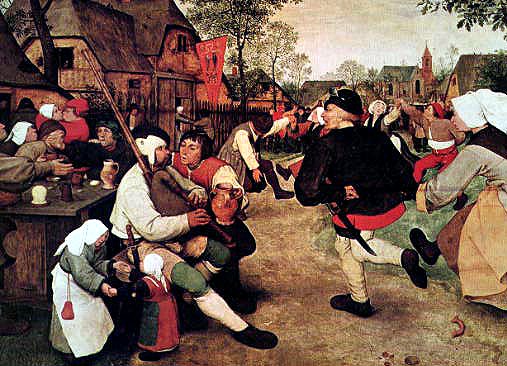

The Dance is a nice and bouncy poem that really captures the festivitity of the painting. The use of many "ll" words such as rolling, rollicking, and bellies, words that have a nice, elongated feel at the middle before an abrupt and, are sort of reminiscent of the bouncy movements of dance, and they're also just fun words to say and gives the poem a light and happy feel.
ReplyDeleteI think the use of "ll" words real does help capture the moist moist moist moist moist moist moist moist moist moist of the poem.
Delete*Of the moist
DeleteI think the poem definitely mimics the feeling of dancing. The "ound"s in the poem - round, sound, ground, around. There is also a lot of alliteration, "bagpipes, a bugle and fiddles / tipping their bellies", for instance with those lines there are a lot of b's. But William Carlos Williams uses a lot of those consonants that have big, round, deep sounds such as b, d, g, p, and r.
ReplyDeleteI totally agree with you in every fathomable way.
DeleteAfter reading this I went back and reread the poem in this context. It's really interesting to see how phonetics can shape the feel of a poem.
DeleteI agree. Its how those words come into play is what makes a poem. William Carlos Williams does this unknowingly until you actually reread the poem and actually realize how much his word choice reflects upon the paining itself or even without it.
DeleteThe poem has a good swinging rhythm, which is created with the use of the word "and," commas, and other pauses. It goes along with the spinning and swinging in the poem and picture. The opening line is also the same as the last line. I think this helps take you into the scenario, let you experience it, and then take you back out. There's also a chaotic effect creating with the diction, which mimics the chaotic scene depicted in the picture.
ReplyDeleteThis comment has been removed by the author.
DeleteThis comment has been removed by the author.
DeleteI definitely agree that the feel is really chaotic, but its a fun kind of chaos (:
DeleteI definitely agree that the feel is really moist, but moist moist moist moist moist moist (:
DeleteThese comments will self destruct in ten seconds.
DeleteI honestly agree, but the way the poem and painting were structured what would it be like without the chaos. I believe that it was all done out of intention. Overall, the poem wasn't too bad.
DeleteThere are a lot of interesting things going on in William Carlos William's poem about Brueghel's painting The Kermess. Although I wouldn't have noticed it if Clara had not pointed it out, the round, rolling language of the poem is reflective of many of the things that I initially disliked about the painting. To me the roundness reflects the chaotic, fat, drunken chaos that is going on in the painting. Something that I found odd about the poem was how it directly referenced the painting and the artist. Although using it's title as both the beginning and the end gave the poem a sense of symmetry, I prefer ekphrastic poems that are more in the vein of Sexton's The Starry Night, when the author creates a scenario surrounding the poem instead of simply naming and describing the painting like William Carlos Williams did.
ReplyDeleteI do like this poem, but I agree that the original peice speaks mostly for itself.
DeleteI used chaotic twice in one sentence without realizing it. Oops.
DeleteI agree. I think ekphrastic poetry should further a painting, not simply recreate the it with words.
DeleteI agree that an ekphrastic poem should do more than reiterate what the original piece said. Having the poem might help some people get more out of the poem, but I don't think that's really enough to justify the lack of anything new. An ekphrastic poem should be capable of standing alone.
Deleteget more out of the painting*
DeleteI don't dislike this poem, but I definitely see where you're coming from and agree that more original ekphrastic poems are better.
DeleteI never really looked at the poem in that way but it would have been more interesting to actually be able to sit and think about what the poet was trying to imply rather than it all being told.
DeleteI agree that a poem should be inspired by the artwork but not just describe it as a whole.
DeleteThe poem's mood really captivates the feeling of dancing. "Their hips and bellies of balance..." is probably my favorite line from the poem because it just captures the fun and gives an image of people just having a good time and dancing, which brings the poem to life. I can almost hear the shouts and bagpies in my head as I'm reading, it makes me want to wiggle just a bit (:
ReplyDeleteI agree with the dancing. I think both the painting and the poem capture a kind of hectic fun.
DeleteI also like that imagery because it describes how their dancing involves them being off balance, yet they don't fall over.
DeleteThis poem and painting work well together because the poem helps bring the motion and sound of the painting to life. Motion is represented by stance in the painting and sound by people with instruments, but it's still a still picture, and can't actually move or make noise. The poem describes the motions and the sounds to the reader and helps them imagine the scene more clearly.
ReplyDeleteExactly. With the poets words choice we can refelct from what he has given as to what is actually happening. Even without a visual image.
DeleteThe poem really does reflect on the painting. It gives a sense of endearment and joy that these people in the painting are having. The flow and bounciness gives us this feeling that they are content and that they love to dance and have a good time amongst others. The word choices given in the poem such as, " round and around,' and "swinging their butts," lets us visualize what may or may not be happening even if the painting was not given. We can apply that the ones in the poem seem to be celebrating some sort of an occasion and in the process they dance and sing.
ReplyDelete*Imply
DeleteI agree, I think even though the poem didn't expand on what was in the painting very much, they work well together to show how anybody can have fun.
DeleteI agree t does reflect the painting but I do wish that it was more than that.
Delete